Find answers to
common questions.
Everything you need to know about Novoflex products, solutions and services.
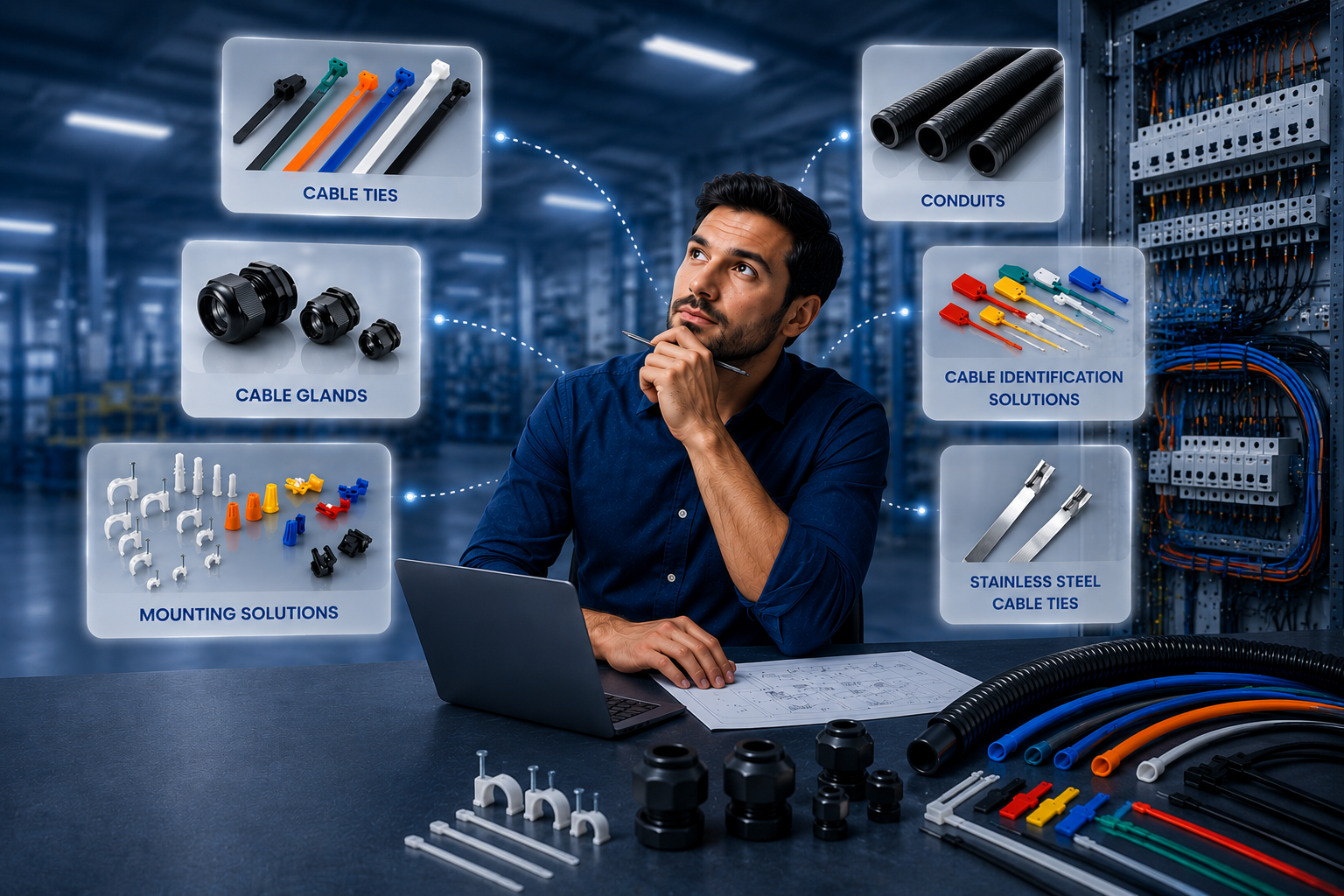
Browse by Category
Depending on the product category, Novoflex products are manufactured using UL-approved Nylon 6.6, stainless steel, polypropylene, and other engineering-grade polymers.
In order to provide the best quality, we use only Nylon sourced from global market leaders.
Nylon 6,6 is a highly hygroscopic material which actively absorbs and releases moisture from the atmosphere based on the prevalent atmospheric conditions where it is stored. The moisture content significantly affects the mechanical properties of the raw material as well as the finished products, especially with regards to the flexibility and minimum loop tensile strength.
When Nylon is exposed to 100% relative humidity, it can absorb upto 8.5% moisture which reduces the loop tensile strength by upto 50%. A higher moisture content leads to a lower loop tensile strength and the highest loop tensile strength is achieved in a Dry As Moulded (DAM) condition.
Cable ties conditioned with moisture content between 2 – 4%, depending on the seasonal changes at the time of the year, are shown to have the ideal balance between flexibility and loop tensile strength prior to installation. After achieving positive locking, the cable ties enter a static condition and any further changes in moisture content are insignificant.
Polypropylene is largely unaffected by moisture content in the atmospheric conditions and hence the effect on loop tensile strength is negligible. Stainless Steel both coated and uncoated are unaffected by moisture and there is no effect on loop tensile strength.
Novoflex adjusts and processes its products according to the atmospheric conditions prevailing at the time of manufacturing. For specific requirements of atmospheric conditions, please inform us and we will process the material accordingly.
Depending on the product category, Novoflex products are manufactured using UL-approved Nylon 6.6, stainless steel, polypropylene, and other engineering-grade polymers.
In order to provide the best quality, we use only Nylon sourced from global market leaders.
Nylon 6,6 is a highly hygroscopic material which actively absorbs and releases moisture from the atmosphere based on the prevalent atmospheric conditions where it is stored. The moisture content significantly affects the mechanical properties of the raw material as well as the finished products, especially with regards to the flexibility and minimum loop tensile strength.
When Nylon is exposed to 100% relative humidity, it can absorb upto 8.5% moisture which reduces the loop tensile strength by upto 50%. A higher moisture content leads to a lower loop tensile strength and the highest loop tensile strength is achieved in a Dry As Moulded (DAM) condition.
Cable ties conditioned with moisture content between 2 – 4%, depending on the seasonal changes at the time of the year, are shown to have the ideal balance between flexibility and loop tensile strength prior to installation. After achieving positive locking, the cable ties enter a static condition and any further changes in moisture content are insignificant.
Polypropylene is largely unaffected by moisture content in the atmospheric conditions and hence the effect on loop tensile strength is negligible. Stainless Steel both coated and uncoated are unaffected by moisture and there is no effect on loop tensile strength.
Novoflex adjusts and processes its products according to the atmospheric conditions prevailing at the time of manufacturing. For specific requirements of atmospheric conditions, please inform us and we will process the material accordingly.